
SAPA Annual Conference 2026 · Conference briefings
SAPA 2026 — A Physician's AI Journey, in 90 Seconds
An animated summary of Dr. Lun-Hsiang Yuan's SAPA 2026 talk: from using AI to building trustworthy medical AI workflows.
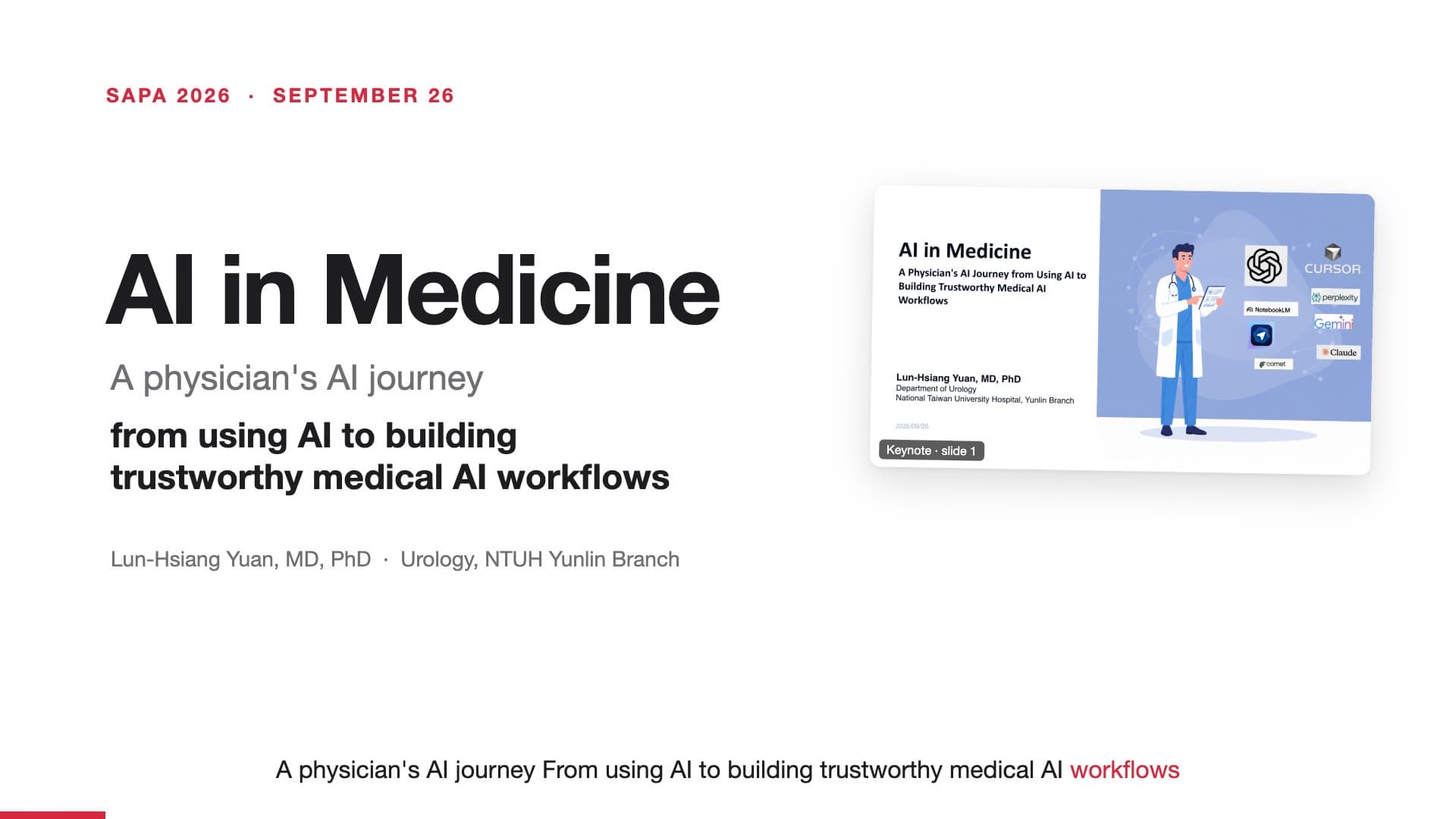
/ watch /
Watch the talk in 90 seconds
The animation follows the talk in nine short scenes: a 2024 language-model study, the move from chatbots to agents, AI as a daily assistant, the physician as principal investigator of an agent team, what clinical AI needs for oversight, who stays in the loop, and what AI means for clinical skill.
Animated summary of the SAPA 2026 talk. The narration is AI-generated speech; captions are shown on screen.
Source: SAPA 2026 slides and talk script
/ takeaways /
Four takeaways
In our 2024 study in The World Journal of Men's Health, four large language models read multi-modality prostate cancer work-up reports. For LATITUDE high-risk classification, GPT-4 turbo reached 90.1% accuracy, ahead of Claude 3 Opus (76.8%), Gemini Pro 1.0 (61.2%) and GPT-3.5 turbo (35.1%).
Agents now work toward a goal with tools, memory and feedback. In research, the physician becomes the principal investigator of an agent team — literature, data, analysis and writing agents — and reviews every draft.
A car without a driver still needs oversight, and so does clinical AI: governance, patient privacy, clinical evidence, human accountability, workflow integration and ongoing monitoring. For patient care, humans stay responsible and AI assists. For automated tasks such as billing and coding, AI can do the work with human checkpoints.
Used well, AI can create a second peak in a clinical career. Used carelessly, it risks deskilling, mis-skilling and never-skilling — a concern for residents and medical students.