
ESMO Congress 2026 · Conference briefings
ESMO 2026: Two Drug Classes, Read Before the Doors Open
Antibody-drug conjugates fill ESMO 2026 by volume. PD-(L)1×VEGF bispecific antibodies are far fewer, but a phase 3 trial of one reaches a Presidential Symposium. We read 4,325 abstracts to see where each one stands, and what is still missing.
/ 01 /
Size of the room
Start with what we could actually read. The official interactive programme lets a signed-in attendee open each abstract's full text, and we saved what was reachable on October 20–21: 4,325 abstracts, made up of 310 presentations, 2,025 posters and 1,990 ePosters. That is enough to see the shape of the meeting days before it opens.
These abstracts are not the whole meeting. The presentation calendar lists 1,788 cards across 298 sessions, but most cards carry no visible abstract text, and late-breaking abstracts (LBAs) only go online at 00:05 local time on the day they are presented. So no LBA results are counted here. For a reader, that makes every count here a floor, not a ceiling: the stage in Madrid can only add to it.
Within the 4,325, a fixed, case-insensitive keyword search of titles and abstract text flagged 496 abstracts that name an ADC, mention PD-1 or PD-L1 together with VEGF, or use bispecific terms. A keyword hit is only a lead, so each of the 496 was then read and sorted one by one, and the categories overlap. For a reader, this means the counts below describe what the programme put on paper before Madrid; they say where the field is placing its bets, not which bets will pay off.
/ 02 /
ADCs carry the volume, and the hard questions
Of the two classes we screened, ADCs are the larger by a wide margin. An ADC is an antibody that carries a cytotoxic drug (the payload) to cells that show its target. 343 abstracts mention one; in 202, the ADC is the treatment being studied.
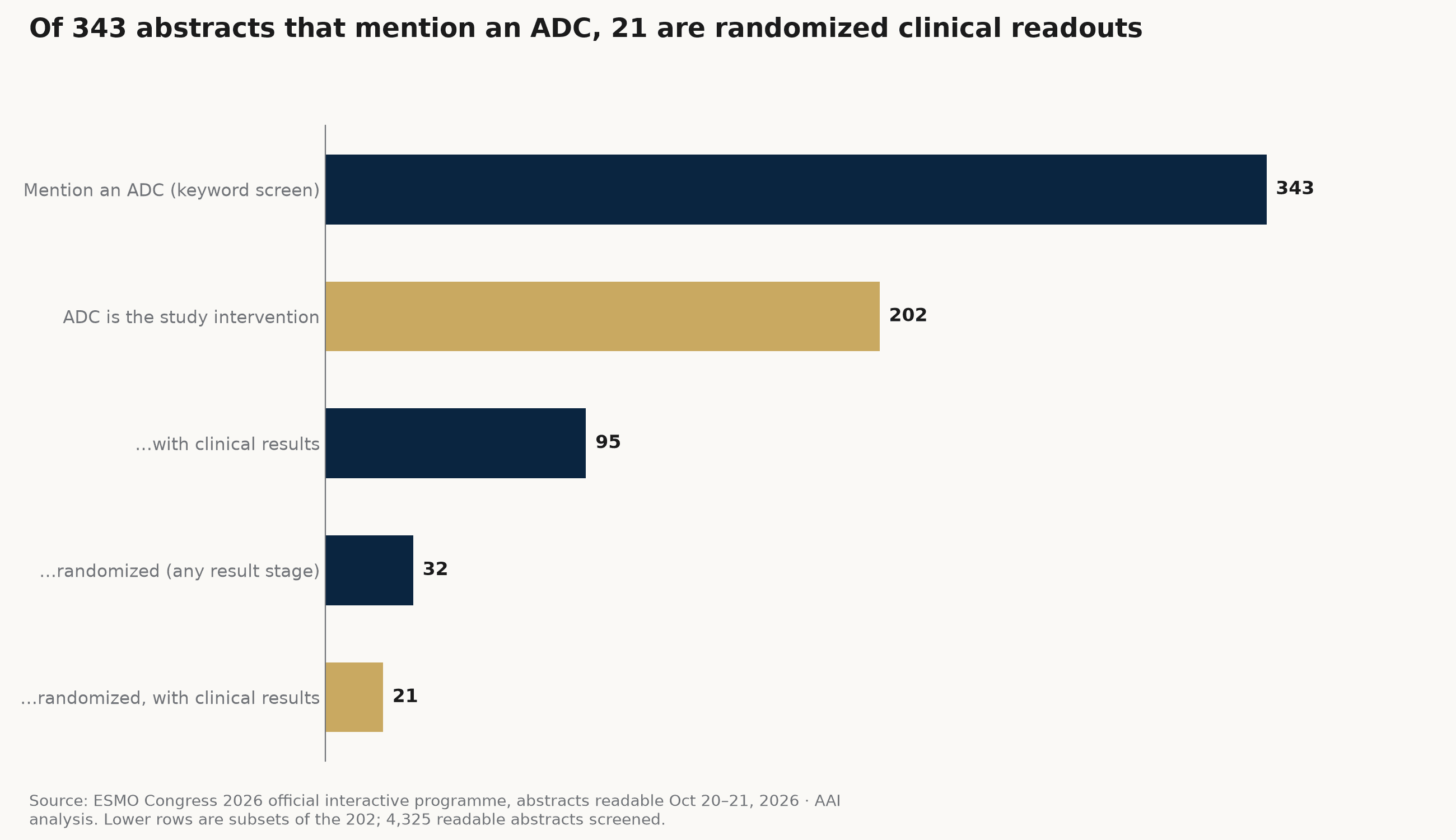
How the ADC abstracts sort. Of 343 that mention an ADC, 202 test one as the intervention; 95 of those report clinical results, 32 are randomized, and 21 are both.
Source: ESMO Congress 2026 official interactive programme (abstracts readable Oct 20–21, 2026) · AAI analysis
Most of those 202 are early. 95 report clinical results, 32 are randomized (some still enrolling), and 21 are both; the rest are protocols, real-world reviews or lab work. So the ADC volume mostly shows how many programmes are in motion, not how many answers are in.
The randomized end is where the weight sits. The final overall-survival analysis of OptiTROP-Breast01 (4639RO; 263 patients with pretreated triple-negative breast cancer) reports median survival of 14.7 months with sacituzumab tirumotecan versus 9.9 months with chemotherapy (hazard ratio 0.60), with survival as a key secondary endpoint. Of the four ADC- or bispecific-related LBAs we are tracking, three include an ADC, in bladder, gastroesophageal and endometrial cancer; their results are not public yet.
Volume also brings the safety bill into view. Two pooled analyses describe lung inflammation (interstitial lung disease, ILD), a known ADC risk: 22 of 723 patients (3%) with tambotatug pelitecan (YL201; 1057P), and 12 of 301 (4%) with risvutatug rezetecan (1068P), including one treatment-related death. Neither has a comparison arm, so they describe the risk rather than rank it; what they tell a reader is that lung monitoring travels with every new ADC.
/ 03 /
Bispecifics: fewer abstracts, bigger first questions
PD-(L)1×VEGF bispecifics are the fast-moving class, not the large one. These are single antibodies built to block an immune checkpoint (PD-1 or PD-L1) and a blood-vessel growth signal (VEGF) at once. Sorting them out took real reading.
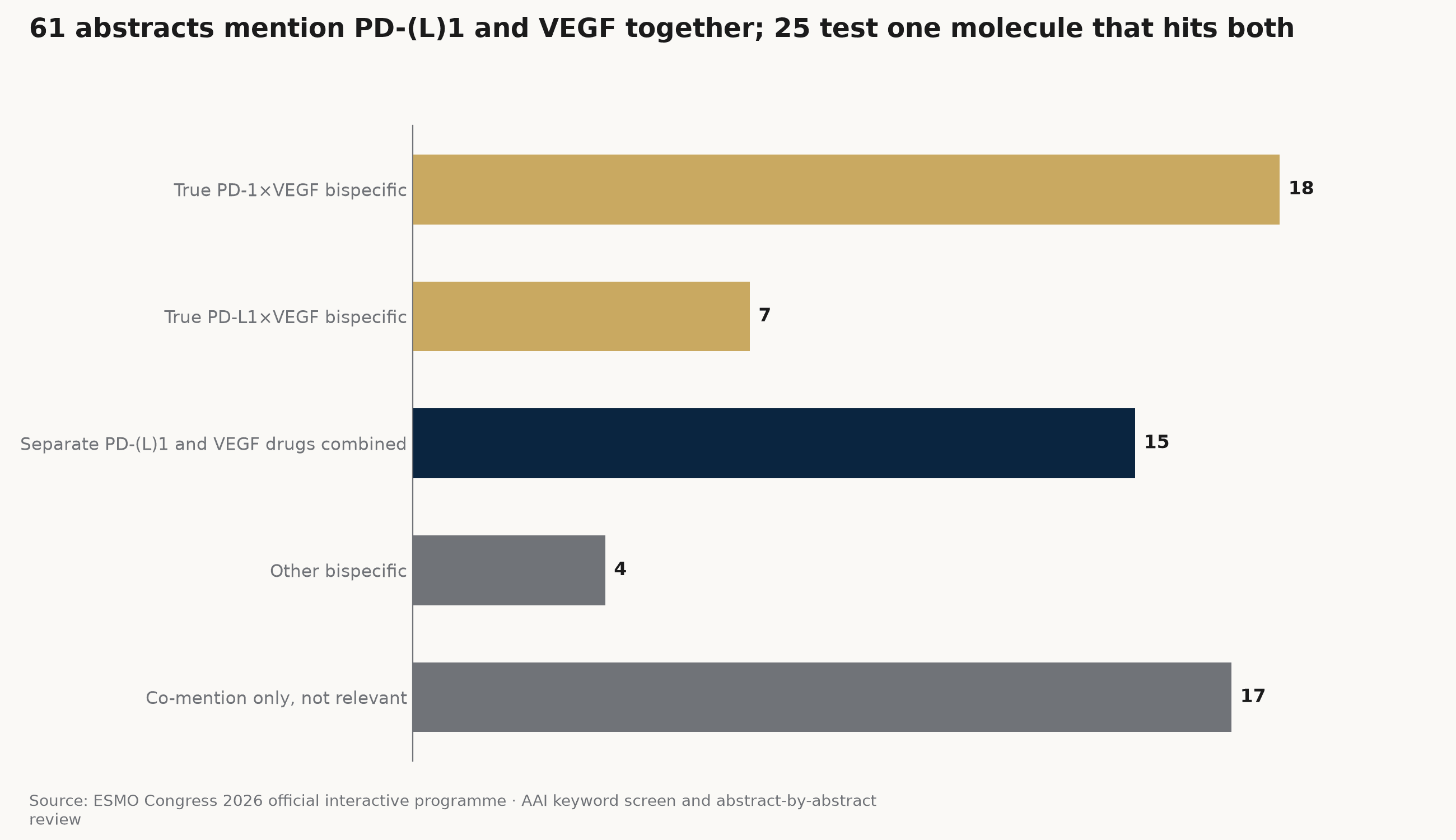
Of 61 abstracts that mention PD-(L)1 and VEGF together, 25 test a true bispecific antibody. Fifteen combine two separate drugs; the rest are other bispecifics or co-mentions only.
Source: ESMO Congress 2026 official interactive programme · AAI keyword screen and abstract-by-abstract review
61 abstracts mention PD-(L)1 and VEGF together. Only 25 test one molecule that hits both: 18 against PD-1 and VEGF, 7 against PD-L1 and VEGF; another 15 give two separate drugs side by side, which is a different question. For a reader, the lesson is to check whether a "PD-1/VEGF" title means one molecule or two.
Most of the 25 are small and single-arm, and only 7 are randomized. In a randomized phase II in first-line lung cancer (2660P), PF-08634404 (tivunatamig; developed by 3SBio and licensed to Pfizer) plus chemotherapy was compared with the PD-1 antibody tislelizumab plus chemotherapy: at the dose chosen for phase 3, confirmed response was 75.0% versus 44.7% in non-squamous disease, and across doses grade 3 or higher VEGF-related side effects ran 7.9% versus 1.4%. The biggest test is still ahead: HARMONi-GI1 (sponsor: Akeso), a double-blind phase 3 of ivonescimab plus chemotherapy against durvalumab plus chemotherapy in biliary tract cancer, is LBA8 in Presidential Symposium II on October 25.
The two classes are starting to meet. Three abstracts pair an ADC with a true PD-(L)1×VEGF bispecific (999O, 1777P and 2910P), including a small randomized phase II in CLDN18.2-positive gastric cancer (2910P; 21 patients per arm). These are early safety and activity signals, not yet answers, but they show where the next combination trials are likely to come from.
/ 04 /
Where the work touches the clinic: what comes after an ADC
The practical question for patients is no longer whether ADCs work, but what to give next when one stops working. Several abstracts take that on directly, and the early answers are sobering.
One prospective platform trial, SWITCH (4RO), moved 54 patients with HER2-negative breast cancer to an ADC with a new target, but a similar payload, after an earlier ADC failed. Confirmed response rates across its four groups were 0%, 8.3%, 0% and 5%. Each group was small and the trial was not head-to-head, so it cannot rule the strategy out, but it is not an endorsement either.
The biology offers clues. In paired tumor samples taken before treatment and after progression (4449RO), HER2 protein fell in 8 of 14 patients exposed to trastuzumab deruxtecan. Separately, the Nectin-4 ADC bulumtatug fuvedotin (4640RO), given after a prior topoisomerase-I-based ADC, reached a 30.0% response rate in 60 evaluable patients with triple-negative breast cancer in a single-arm study. Together they suggest that switching the target may matter less than understanding why the first ADC stopped working.
For readers planning the week, three sessions are worth blocking out, all 16:30–18:15 Madrid time. Presidential Symposium I on October 24 carries LBA2 (VOLGA, bladder cancer); Presidential Symposium II on October 25 carries LBA7 (CLARITY-Gastric 01) and LBA8 (HARMONi-GI1); Presidential Symposium III on October 26 carries LBA11 (TroFuse-005, endometrial cancer). LBA results appear only on their presentation day, so until then any claim about how these trials turned out is a guess.
/ 05 /
What we take, and where AI is still small
Put together, the programme reads as two different stages of a drug class's life. ADCs are in their crowded middle years, with randomized wins, a visible safety cost and an open sequencing problem. PD-(L)1×VEGF bispecifics are at their first big randomized tests.
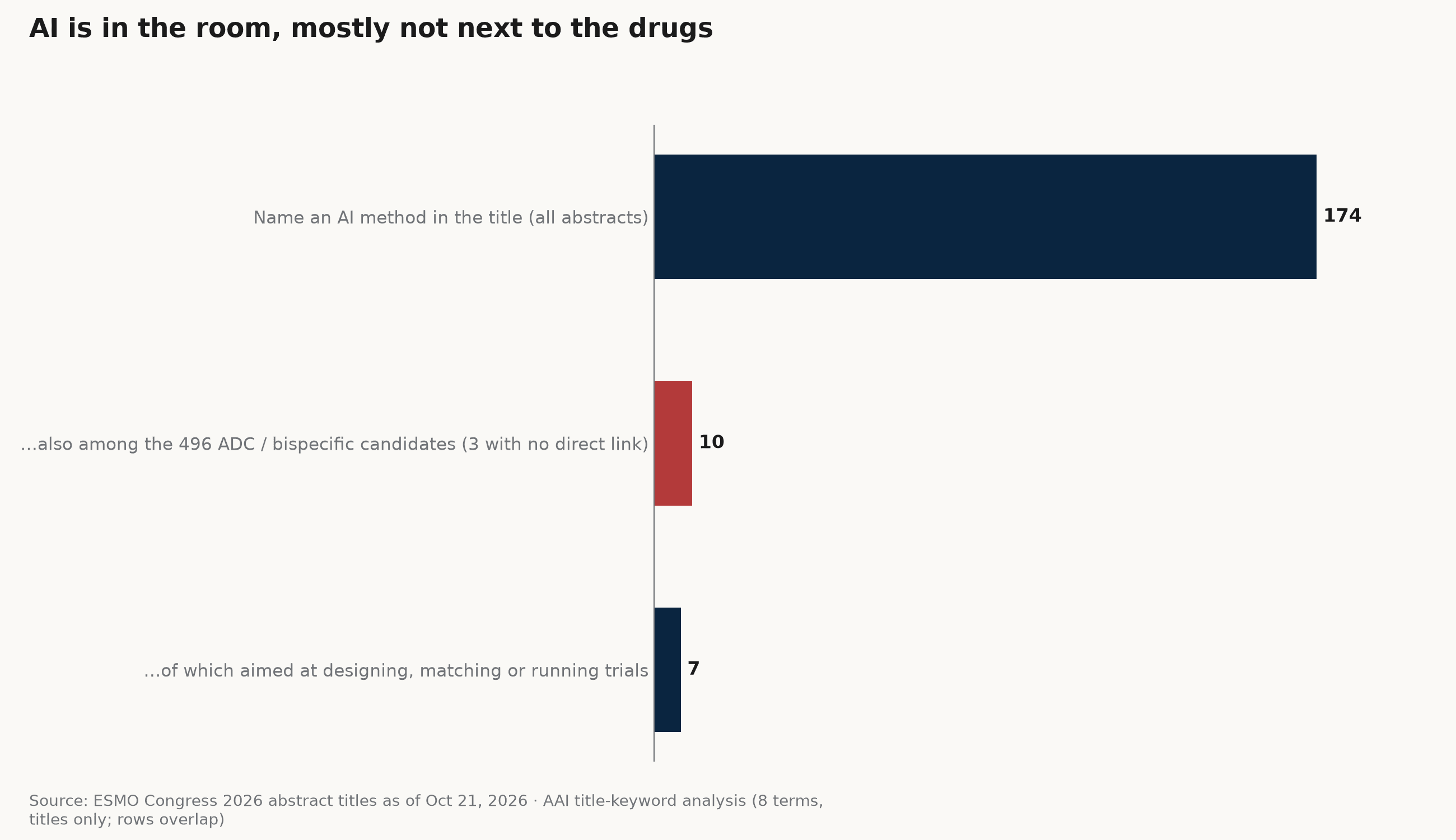
174 abstract titles name an AI method; 10 of them are also among the 496 ADC and bispecific candidates (3 with no direct link to either class), and 7 aim AI at designing, matching or running trials. Titles only; rows overlap.
Source: ESMO Congress 2026 abstract titles, as of October 21, 2026 · AAI title-keyword analysis
AI is present but off to the side. We searched titles only, case-insensitively, for eight terms, including hyphenated and plural variants: artificial intelligence, machine learning, deep learning, AI, large language model, LLM(s), neural network and foundation model. That finds 174 abstracts, about 4% of what we read, yet only 10 of them are also among the 496 ADC and bispecific candidates, and 3 of those (185P, 315P and 161eP) are prostate cancer studies with no direct link to either drug class; 161eP, an AI analysis of conference-abstract topics, was included only because "ADC" appears in its text. Of the other 7, four read pathology or score a biomarker, such as HER2-ultralow or PD-L1 staining, one reads tumor response on scans in an ADC trial, and two describe drugs designed with machine learning.
The AI that touches trial design is elsewhere: 7 titles (124P, 125P, 128P, 129P, 132P, 134P and 193P) use it to draft protocols, screen eligibility, match patients or predict trial outcomes, and none is tied to these two drug classes. That gap is where we work. Questions like which ADC to give after which, or which patients a bispecific should be tested in first, are exactly where better use of trial data could help, and we expect to see more of that at future meetings.