
ESMO Congress 2026 · Conference briefings
ESMO 2026: AI reaches the trial, not yet the bedside
More than 200 abstracts at ESMO 2026 mention AI, and three made the late-breaking stage. The work to watch is already inside trial operations: AI reads tumour scans in an ADC trial (131P), pre-screens 12 lung cancer biomarkers from one pathology slide (320P), and pulls lines of therapy out of medical records (145P). Most of it is retrospective and still far from changing patient outcomes.

/ 01 /
Three talks on the main stage: big questions, early evidence
A full-text keyword search (titles and abstract bodies) of the public general abstracts in the official programme, for terms such as artificial intelligence, machine learning, LLM, deep learning and digital pathology, returns 197 abstracts. Adding one AI oral session and three AI LBAs gives about 201. ESMO has not published an official AI count, so the figure only indicates scale.
LBA18 (BEAGLE®-MDT, funded by Histofy) had AI write patient summaries, management suggestions and trial matches for 15 synthetic colorectal cancer cases. Five experts scored them blind on a 5-point scale, with mean scores of 4.50–5.00, 4.07–4.87 and 4.33–4.93 for the three tasks. The authors state that this does not show clinical benefit and needs prospective validation.
LBA19 (ALLIANCE, NCT07198581), led by Incheon St. Mary's Hospital of the Catholic University of Korea, is the only randomised study of the three. Patients receiving chemotherapy for breast or colorectal cancer at one centre were randomised 1:1 to physicians with LLM access or usual care. The trial planned an interim analysis and enrolment stop at 60 patients and analysed 56. The LLM arm recorded more adverse events (150 vs 78; 5.4 vs 2.8 per patient; p=0.006), with similar dose-reduction rates (12/28 vs 14/28). The primary endpoint was change in EORTC QLQ-C30 global health status, but only slightly more than half of patients were evaluable at end of treatment, and the toxicity classification was post hoc. Whether the extra events reflect better care or different recording, the interim analysis cannot tell.
LBA20 (no funding) trained a model on 70,000 H&E whole-slide images to emulate the 70-gene MammaPrint test, then validated it retrospectively in 372 early breast cancer patients from the prospective RASTER cohort. At a median follow-up of 10.3 years, 10-year breast cancer-specific survival was 98.1% for model low-risk patients and 86.7% for high-risk patients (HR 0.12, 95% CI 0.04–0.39). Chemotherapy use differed sharply between the groups (74% vs 24%). This is prognostic stratification; it does not tell physicians who will benefit from treatment.
All three were presented on the afternoon of 24 October (Madrid time): LBA18 14:45–14:55, LBA19 14:55–15:05, LBA20 15:39–15:49.
Design — LBA18 BEAGLE®-MDT: Synthetic-case pilot; LBA19 ALLIANCE: Randomised interim analysis; LBA20 digital MammaPrint: Retrospective validation.
Denominator — LBA18 BEAGLE®-MDT: 15 synthetic cases, 5 expert raters; LBA19 ALLIANCE: 56 analysed; LBA20 digital MammaPrint: 372 validated.
Lead / funding — LBA18 BEAGLE®-MDT: Authors; Histofy; LBA19 ALLIANCE: Incheon St. Mary's Hospital; LBA20 digital MammaPrint: Authors; no funding.
Question it can answer — LBA18 BEAGLE®-MDT: Feasibility; LBA19 ALLIANCE: Safety and feasibility; LBA20 digital MammaPrint: Prognostic stratification.
/ 02 /
The real news is in the poster hall: AI enters trial operations
131P applies AI to the response-assessment process of a drug trial itself. Pfizer is the legal entity and the funder. The study is the phase 1 trial (NCT05208762) of the PD-L1-directed ADC fetrastobart vedotin (PDL1V/PF-08046054) in 55 patients with non-small cell lung cancer, stratified by PD-L1 positive (37) and negative (18). Investigator RECIST 1.1 reads were compared with human-reviewed, AI-assisted central reads. Patient-level agreement was 84.0% and timepoint-level agreement 72.3%.
This is an exploratory endpoint in a single-arm study; it compares two ways of reading scans, not drug efficacy. The authors write that AI-assisted confirmed objective response and disease control rates were consistent with investigator-assessed outcomes, and that an independent AI-assisted central read confirmed the investigator-read results, supporting the phase 3 PADL1NK-005. They add that this shows AI-assisted RECIST 1.1 reads are feasible in a prospective trial. This is the authors' statement; it does not mean efficacy has been confirmed. The next question is whether PADL1NK-005 uses the same read process.
Trial screening is the second thread. 124P (run by the authors, no funding) used neurosymbolic AI to match 76 lung cancer patients to 17 trials in a prospective "silent trial": the AI ran in the background without touching care, and its output was compared with the consensus of five oncologists. Screening time per case fell from 4.46 minutes to 1 minute, 49.4% of cases were flagged for high-confidence automatic screening, and the abstract reports no false positives. 132P (funded by Paradigm Health and Fujitsu) applied a reasoning LLM to the eligibility criteria of a multinational trial for 353 Japanese lung cancer patients, 3,530 patient-criterion pairs in all. 327 patients (92.6%) failed at least one criterion; for 299 of 350, histological subtype evidence was insufficient.
132P points at the records themselves: the AI screens faster and shows which data the charts are missing.
AI is also starting to assemble real-world evidence. In 145P (run by the authors, no funding), an LLM agent that calls its own retrieval tools extracted lines of therapy from colorectal cancer records. A GI oncologist had reviewed the same 100 patients and 430 lines by hand. The agent finished all 100 cases, and the line count was within one line in 88% of patients (ICC 0.90). Full-regimen accuracy was 76.3%, close to the 73.9% agreement between a second oncologist and the first (McNemar p=0.68). Manual review takes about an hour per patient.
All four studies come from single sites. 124P did not touch care, and 132P and 145P are retrospective. Deployment still needs answers on data sovereignty and audit trails.
/ 03 /
Reading molecules from slides: digital pathology and patient selection
320P has the most cases of the studies covered here. Tempus AI is the legal entity and Pfizer the funder. The model predicts 12 biomarkers at once from H&E slides of advanced non-small cell lung cancer, trained on 60,459 cases from 56,969 patients, 41,680 of them with IHC results. Thresholds were set for 90% sensitivity and then tested on a holdout set. Sensitivity was above 80% for every marker: 92.49% for ALK fusion (ROC AUC 90.06%) and 89.38% for EGFR (AUC 88.37%). The cost is low specificity, from 41.66% to 78.26%. The authors frame it as pre-screening to prompt confirmatory testing, not as a replacement for NGS or IHC.
315P does the same with imaging. Led by Yonsei University Health System and funded by the National Research Foundation of Korea, it used biparametric MRI to identify BRCA1/2 mutations in 569 patients with advanced prostate cancer at two hospitals. AUROC in the two external cohorts was 0.813 and 0.817. At a fixed sensitivity of 0.85, negative predictive value was 0.96, and the combined external cohorts could skip 55.1% of NGS tests. But the external cohorts had only 15 and 21 BRCA-positive patients, and the confidence intervals are wide (0.633–0.954 and 0.691–0.918).
306P tests a treatment interaction in randomised data. Ataraxis AI, developer and funder, applied its causal AI pathology model ATX to 570 node-positive HR+/HER2- early breast cancer patients from the UNIRAD trial (NCT01805271). The model classed 267 (47%) as high risk, and risk group interacted with everolimus assignment (interaction HR 3.29, 95% CI 1.19–9.10, p-interaction 0.022). It is a post hoc analysis run by the developer and should be read as a hypothesis.
550P showed no significant interaction. Led by the NSABP Foundation and funded by the NSABP Foundation and PreciseDx, it applied an AI-derived histologic grade (AI-Grade) to 1,607 hormone receptor-positive, node-negative breast cancer patients from NSABP B-20, with 14.2 years of median follow-up. AI-Grade high-risk patients had lower distant recurrence with adjuvant chemotherapy (HR 0.60, 95% CI 0.41–0.87; 12% absolute 10-year difference), and low-risk patients showed no significant difference (HR 0.81). The chemotherapy-benefit interaction was not significant (p=0.23), so AI-Grade cannot yet be called predictive of chemotherapy benefit. Its prognostic signal is clearer: in the tamoxifen-only arm, 10-year distant recurrence-free interval was 71.7% for high-risk and 89% for low-risk patients (HR 2.33).
551P looks for low-risk patients among those at high clinical risk. Karolinska University Hospital led the study without funding, independently validating an AI prognostic assay in 620 node-positive ER+/HER2- patients from Swedish and German sites of the phase 3 PANTHER trial (NCT00798070). The histology-only model, using one H&E slide, classed 23.7% as low risk. Their 10-year breast cancer recurrence-free survival was 95.5%, against 76.9% for the rest (adjusted HR 3.88, 95% CI 1.77–8.50). In patients who would usually be considered for escalated adjuvant therapy, the AI found about a quarter with a very good prognosis.
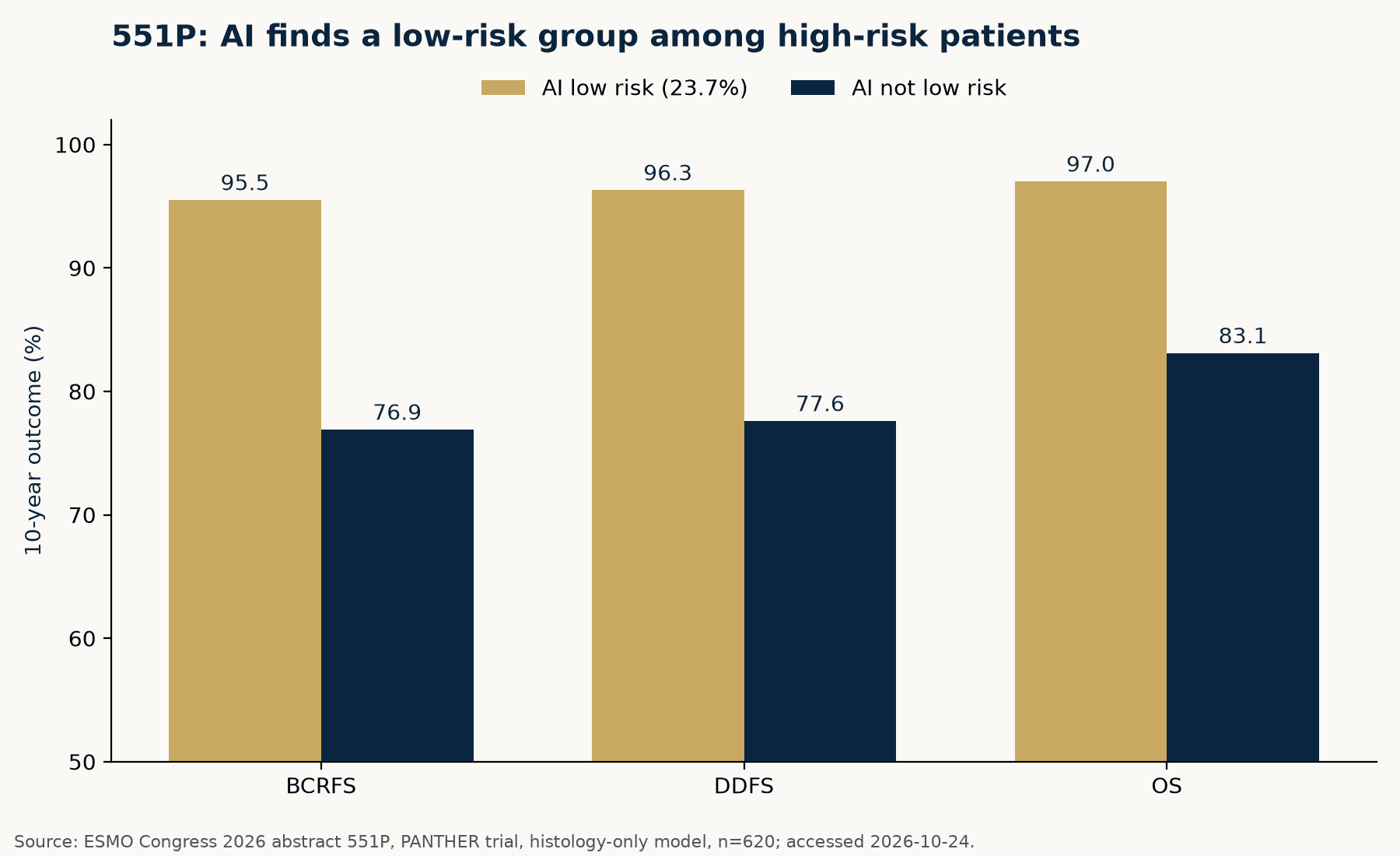
551P: 10-year outcomes for patients classed as low risk or not low risk by the histology-only AI model, among 620 high-clinical-risk patients in the PANTHER trial.
Source: ESMO Congress 2026 abstract 551P (accessed 2026-10-24).
287P takes on the most practical pathology question of the ADC era: how to call HER2-low and HER2-ultralow. Led by Institut de Cancérologie de l'Ouest and funded by AstraZeneca, it had seven AI tools read 297 ER+ breast cancers from two French labs and compared them with expert consensus and Labcorp results. The tools are anonymised and read different numbers of slides, so no single tool can be singled out yet. For ADCs indicated in HER2-low disease, read agreement decides who gets the drug.
320P — Lead / funding: Tempus AI; Pfizer; Input: Lung H&E slides; Patients: 56,969; Key result: Sensitivity >80% for all 12 markers; Evidence: Retrospective, holdout set.
315P — Lead / funding: Yonsei; National Research Foundation of Korea; Input: Prostate MRI; Patients: 569; Key result: External AUROC 0.81–0.82; Evidence: Retrospective, two external cohorts.
306P — Lead / funding: Ataraxis AI; Input: Breast H&E slides; Patients: 570; Key result: Interaction HR 3.29; Evidence: Post hoc analysis of RCT.
550P — Lead / funding: NSABP Foundation; PreciseDx; Input: Breast H&E slides; Patients: 1,607; Key result: Chemo-benefit interaction p=0.23; Evidence: Secondary analysis of RCT.
551P — Lead / funding: Karolinska University Hospital; Input: Breast H&E slides; Patients: 620; Key result: Low-risk 10-year BCRFS 95.5%; Evidence: Independent validation in RCT.
A single H&E slide or MRI scan is being used to estimate what used to need a molecular test or a manual read. Whether it can replace some testing depends on external validation and regulators.
/ 04 /
Multimodal prognostic models: many, mostly retrospective
Another group of abstracts combines clinical, genomic, proteomic or imaging data to predict outcomes.
317P (TRIAGE-IO, developed by Therapanacea, funded by Bpifrance) predicts death within 6 months of first-line PD-1 monotherapy in advanced non-small cell lung cancer. Trained on 166 patients and externally validated on 105 (25 early deaths), it had pooled negative predictive value 0.925 and sensitivity 0.880. 2930P (run by the authors, no funding) used a 20-protein random forest classifier to predict response to preoperative chemo-immunotherapy in locally advanced gastric cancer. In 160 patients, AUC was 0.826, 0.865 and 0.727 for training, internal and external validation, against 0.561 for PD-L1 CPS, but the external set had only 35 patients. 197P (run by the authors, no funding) used explainable machine learning to predict survival after enfortumab vedotin in 544 patients with advanced urothelial cancer from 51 centres in 24 countries; the best model reached a C-index of about 0.60.
175P (legal entity: the authors; funded by the Norwegian Cancer Society) predicted grade ≥3 immune checkpoint inhibitor toxicity from routine pretreatment labs, building the model on 2,028 Dana-Farber patients and validating it on 628 at Yale. External C-indices were only 0.60 to 0.64, but the top and bottom risk tertiles separated clearly, with a 3-month HR of 3.18 (95% CI 1.54–6.57). 4431P (led by Karolinska Institutet, funded by the Swedish Cancer Society and other foundations) used 10 routine clinical values to predict, before sequencing, whether ctDNA fraction in metastatic prostate cancer reaches 8%, the threshold for reliable liquid-biopsy detection of BRCA1/2 alterations. External AUC was 0.83, and model-guided selection cut ctDNA-negative liquid biopsies from 24% to 5%.
These models can seed enrichment hypotheses, but none has prospective validation and their numbers are not comparable. The C-indices around 0.6 in 197P and 175P show that survival and toxicity after treatment stay hard to predict even with large datasets. 4431P is already running a 300-patient prospective validation, one of the few models with a stated next step.
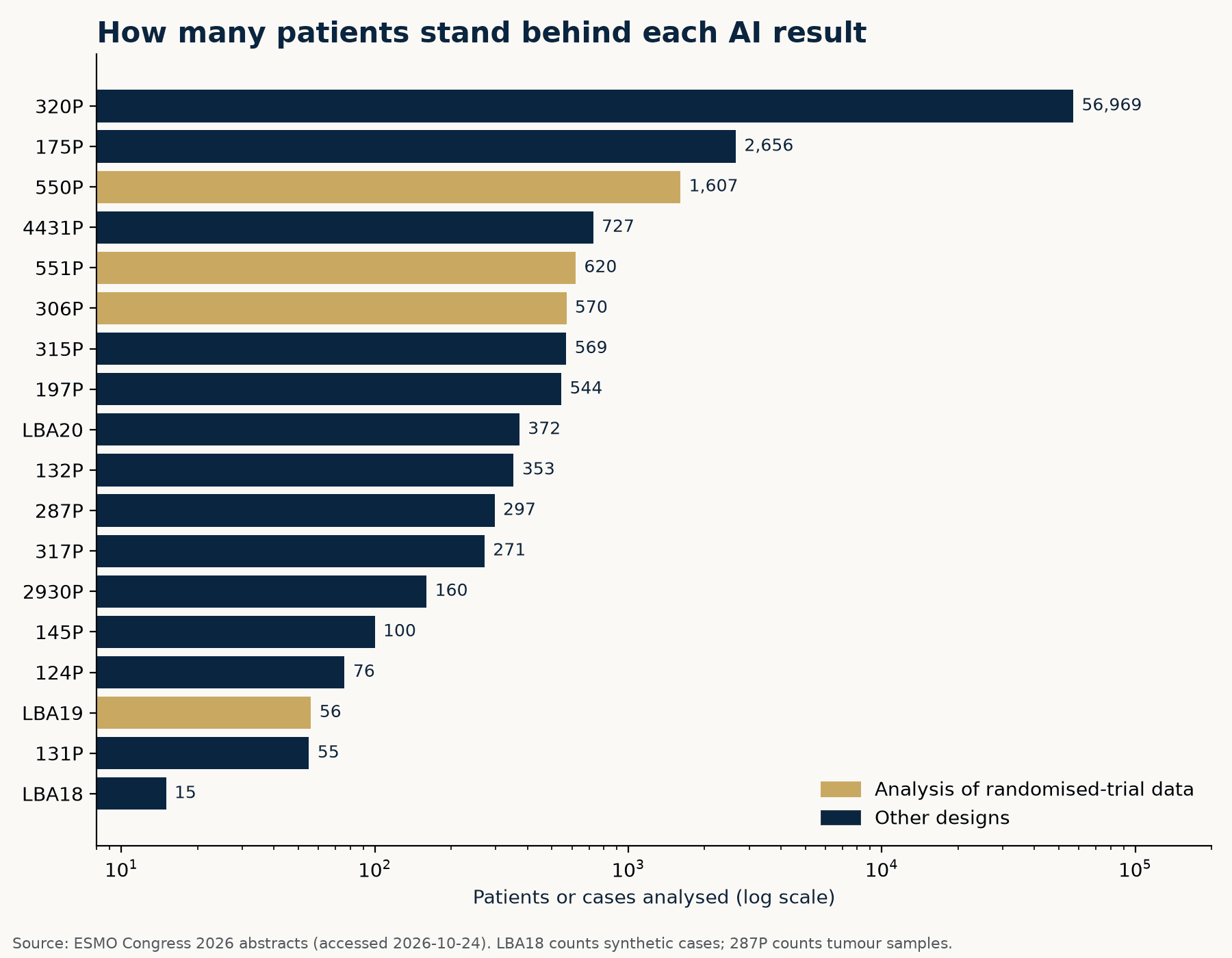
Patients or cases analysed in each AI study discussed here (log scale); gold marks analyses of randomised-trial data. LBA18 counts synthetic cases; 287P counts tumour samples.
Source: ESMO Congress 2026 abstracts (accessed 2026-10-24).
/ 05 /
The gap: AI has not reached the hardest questions
An AI oral session follows on 26 October. Its titles include a federated European real-world evidence platform (117RO, OPTIMA), automated multi-cancer risk stratification from routine clinical data (280RO), an in-silico platform validating human-AI interaction across five cancers (171RO, CHAIMELEON), AI chest X-ray detection of early lung cancer at an Argentine hospital (282RO), and a randomised phase 2 trial of AI-assisted preoperative communication for prostate cancer patients (173RO). Only titles are public; results and lead institutions will be known after the talks.
Across the programme, the gap is plain. AI now reads trial scans, screens patients for trials, organises records and estimates molecular status from slides. Among the studies covered here, none directly addresses the hardest questions in drug development: which ADC should follow which, which patients a new drug should be tested in first, and how to design trials that answer faster. Three of these studies were funded or led by drug companies: Pfizer's 131P and 320P and AstraZeneca's 287P. All three use AI's most mature skill, reading images or slides, rather than trial design.
Next to watch: whether PADL1NK-005 keeps the AI-assisted read, whether HER2 AI reading tools clear the companion-diagnostic bar, and whether ALLIANCE's final analysis shows if an LLM helps patients. Until then, AI in oncology is an assistant, not a decision-maker.